)
)
)
)
)
After more than 35 years designing and refining clinical driving simulators, we've had a front-row seat to how occupational therapy (OT) driving evaluations have evolved, and where they're headed next. This crucial piece of technology is going a long way toward helping people stay safe and protected on the road, along with getting drivers back out there after an accident or other health issue.
An occupational therapy driving evaluation is a clinical assessment conducted by a licensed occupational therapist to determine whether an individual has the physical, cognitive, and visual abilities required to drive safely and independently.
It's vital to understand what an OT driving evaluation measures, how simulators are being integrated into clinical workflows, who typically needs an assessment, and what outcomes patients and providers can expect. Additionally, it's worthwhile to explore how modern simulation technology is helping clinics deliver safer, more objective, and more scalable evaluations.
You can get a deeper look at how simulation supports therapy through STISIM Drive clinical therapy applications. In the meantime, here's what to know about an OT driving assessment, what it looks for, and the ways simulators are using technological advancements to protect more people on the roadways.
An occupational therapy driving evaluation is a structured, clinical assessment performed by a licensed occupational therapist who often has a specialized certification as a Certified Driving Rehabilitation Specialist (CDRS). The goal of this therapy is straightforward, and it's designed to determine whether a patient can safely operate a vehicle or identify what support they may need to be able to do so.
Most evaluations follow a two-part structure that begins with an in-clinic clinical assessment. This generally takes 60 to 90 minutes and occurs in a clinic setting. It evaluates foundational abilities such as vision, cognition, and motor function, and includes standardized tests and observational assessments.
In some cases, the therapist may recommend a behind-the-wheel evaluation in a real vehicle. It's important to clarify the scope of this evaluation, in that occupational therapists don't revoke or issue driver's licenses. Instead, they provide clinical recommendations to physicians, licensing agencies, and families based on their objective findings.
OT driving evaluations serve a wide range of populations and are frequently used for individuals with medical conditions that may affect safe driving ability. Common groups of patients who are evaluated in this way include:
Stroke survivors
Traumatic brain injury (TBI) patients
Individuals with Parkinson's disease or multiple sclerosis
People with epilepsy
Those experiencing early or progressive dementia
Older adults with age-related decline
Teens with ADHD or autism spectrum disorder
Individuals with spinal cord injuries
Referrals typically come from physicians, neurologists, or rehabilitation specialists, and in many cases, a physician referral is required before an evaluation can be scheduled. Families may also initiate the conversation when they notice concerning changes in driving behavior, which can occur with age or certain medical conditions.
The stakes are high because driving is closely tied to independence, and losing that ability can lead to social isolation, depression, and reduced quality of life. According to the American Occupational Therapy Association (AOTA), maintaining mobility is a critical factor in overall health and well-being. However, it's also crucial to keep unsafe drivers off the roads, and sometimes that means making a hard decision about whether someone's desire for independence is matched with the ability to drive safely.
Driving is one of the most complex everyday tasks people perform. It requires the seamless integration of multiple systems, and OT evaluations are designed to assess each of them. The core clinical variables considered in an occupational therapy driving assessment include visual function, such as acuity, peripheral vision, and contrast sensitivity, along with the patient's visual scanning and attention span.
Additionally, an occupational therapy driving evaluation assesses reaction time, such as braking and steering responses, as well as the patient's ability to divide attention and manage multiple stimuli simultaneously. Other factors that go into the results of this evaluation include processing speed, memory and executive function, judgment and decision-making, motor planning and coordination, and eye-hand and eye-foot coordination.
In clinic assessments often rely on standardized instruments such as the Test of Visual Perceptual Skills (TVPS), cognitive screening batteries, and paper-and-pencil or computer-based reaction tests. While these tools are clinically validated, they measure isolated abilities rather than functional driving performance.
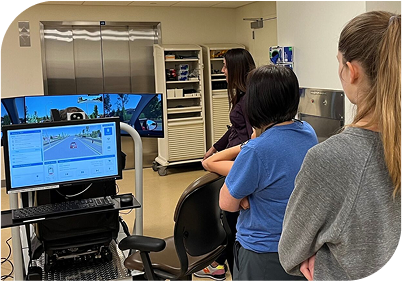
Driving simulators extend the evaluation into a functional real world context by allowing therapists to observe how patients integrate these skills in real time while "driving." Simulators can measure lane position and variability, speed control, hazard detection and response, and a patient's performance under different conditions, such as at night, in the rain, or in traffic, which bridges a critical gap between clinical testing and real-world driving.
Simulators occupy a unique and valuable middle ground between in clinic testing and on-road assessment because they provide a safe, controlled environment in which patients can demonstrate real driving skills and behavior without the risks associated with on-road driving. This is especially important for medically at-risk populations.
One of the biggest shifts simulators introduce is objective measurement. Traditional evaluations often rely on therapist observation and scoring, which is clinically valuable but can also be overly subjective. Simulators, by contrast, capture the patient's reaction time in milliseconds, as well as lane deviation metrics and speed variability. This data can produce vital information on scenario completion rates.
These metrics are valuable because they're objective, not dependent on observer interpretation, and repeatable, since the same scenario can be run multiple times. They're also trackable, making it easy to measure progress over time.
Systems like the STISIM Drive M4000 Advanced Clinical offer 29 customized driving scenarios, a platform used in over 1,200 peer-reviewed studies, and the ability to tailor evaluations to specific patient needs. That can give occupational therapists additional tools to further evaluate patients, improving independence and safety at the same time.
Each evaluation method has strengths and limitations, but the most effective clinical programs use them together.
Criteria | Clinical | Simulator-Based | On-Road |
Safety risk to the patient | None | None | Moderate to high |
Environment control | High | Very high | Low |
Data objectivity | Moderate | High (millisecond precision) | Low to moderate |
Repeatability | High | Very high | Low |
Session duration | 60–90 min | 30–60 min | 45–90 min |
Cost (clinic) | Low | Moderate (equipment investment) | High (vehicle, insurance) |
Population range | Broad | Very broad (including high-risk patients) | Limited (must be road-ready) |
Progress tracking | Limited | Extensive (digital records) | Limited |
Simulators are not a replacement for clinical or on-road testing. Instead, they enhance the evaluation process by providing a safe, measurable way to assess functional driving before or alongside real-world driving.
There are several simulator sizes, and for clinics with space or budget constraints, options like the STISIM Drive M3000 Compact Clinical System offer a more streamlined entry point that can improve patient evaluation and potential outcomes.
Simulation-based driving assessment is supported by a growing body of research. In fact, across thousands of peer-reviewed studies, driving simulators have been used to evaluate performance in medically at-risk populations.
For example, Monash University research (Dimech-Betancourt et al.) demonstrated improved rehabilitation outcomes for individuals with acquired brain injury using simulator-based training and assessment, and East Carolina University's ROADI program developed standardized scoring systems for simulator-based OT evaluations, improving consistency across clinicians.
Some of the biggest key findings of ongoing research studies include:
Simulators can detect impairments that aren't captured in in clinic testing
Divided attention deficits often emerge only during simulated driving tasks
Early cognitive decline can be identified through performance variability
Along with all the study information, additional professional resources are available through the AOTA Driving & Community Mobility Toolkit. This is designed to help with occupational therapy driving assessment concerns, making it easier to help patients stay safe and keep their independence for as long as possible.
In practice, simulators integrate seamlessly into the existing OT evaluation process. The typical workflow might look like this:
Intake and referral
In-clinic clinical screening
Simulator-based evaluation
On-road assessment (if appropriate)
Clinical recommendations and reporting
Simulators enhance this flow by adding a functional assessment layer between screening and on-road testing that can better assess patient readiness for driving in a safe and controlled environment, including whether adaptive equipment should be trialed before a real-vehicle session.
Not only that, but simulators offer several advantages from an administrative perspective, including billable treatment time, because simulator sessions can be reimbursable under OT services, and improved efficiency, since more patients can be evaluated safely. Additionally, there may be enhanced documentation because digital performance data supports reimbursement and reporting.
Platforms like STISIM Drive G4 include integrated patient databases, enabling clinics to track progress over time, generate reports for physicians and insurers, and support clinical decision-making with objective data. However, like with any other piece of technology, successful implementation depends on the therapist's confidence and competence. Driver rehabilitation programs like the STISIM Drive Navigator training program help clinicians integrate simulation into their workflow from day one.
While simulators offer clear advantages, they aren't without limitations. One of the biggest concerns is simulator sickness, where some patients may experience discomfort, including dizziness or nausea. This can typically be managed through gradual exposure, scenario adjustments, and shorter session durations.
It's also vital to note that simulators aren't a replacement for on-road testing. Licensing authorities still require an on-road assessment for final clearance to allow a patient to drive again, and simulators should be viewed as a complementary tool rather than a substitute. Therapist training is essential, too, and without proper onboarding, clinics may not fully realize the benefits of simulation technology.
Driving evaluation is evolving, and clinics are moving beyond subjective observation alone and toward a model that blends clinical expertise with objective, performance-based data. Simulators make that shift possible by offering a safer way to assess at-risk drivers, a more precise way to measure performance, and a more scalable way to deliver care.
If you're exploring how to expand or modernize your driving evaluation program, get in touch with us at STI, and we'll be glad to talk through what that could look like in your setting. There's no one-size-fits-all approach, but with the right tools, you can build a program that's safer, smarter, and helps your patients get ready for what's next.
©2026 Systems Technology, Inc.
)
)
)