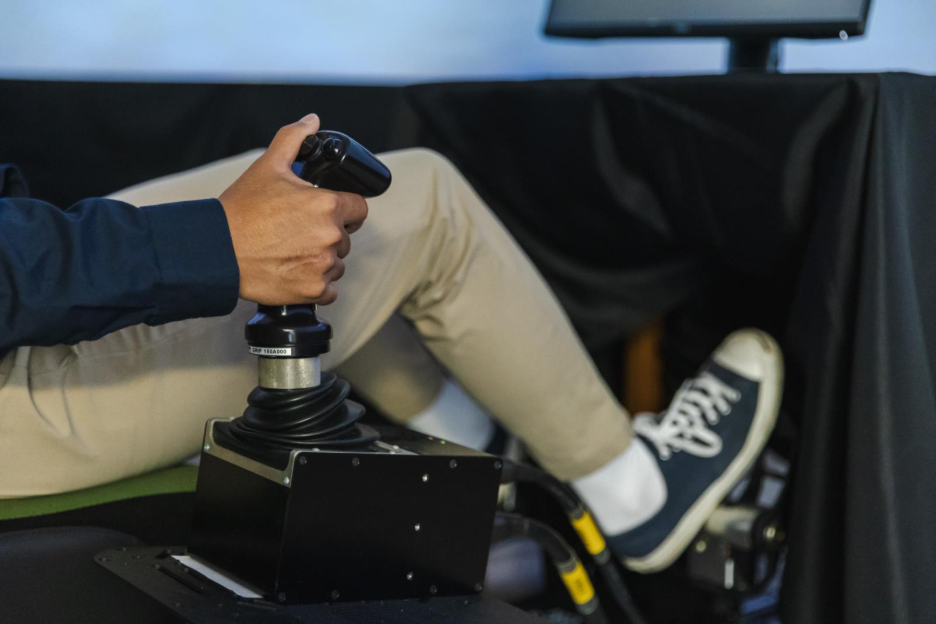
When a test pilot calls a rotorcraft “precise,” “predictable,” and “stable,” they’re describing something engineered—not imagined. That “feel” is the product of control laws, inceptor force-feel shaping, and the underlying pilot-vehicle dynamics.
As rotorcraft progressively adapts fly-by-wire technology, eVTOL developers embrace novel control concepts, and UAS platforms shift toward optionally piloted control philosophies, getting inceptor tuning right has become both more critical and more complex.
For decades, Systems Technology, Inc. (STI) has been the quiet authority behind handling qualities, control-law development, and inceptor behavior. And recent research—including the Vertical Flight Society paper “Handling Qualities Evaluations of Active Inceptors with Varying Force/Feel Characteristics” — reinforces a truth STI has long understood: inceptor tuning fundamentally shapes rotorcraft performance.
Why Inceptor Tuning Is Now a Strategic Requirement
Active, electronically controlled inceptors give designers unprecedented control over breakout forces, stiffness gradients, damping and inertia, mode-dependent force feedback (hover, cruise, automation), soft stops, detents, and haptic guidance, and envelope-protection cueing.
The VFS study shows that force-feel variations directly influence pilot workload, precision and aggressiveness, stability margins, PIO susceptibility, and handling qualities ratings from ADS-33 tasks.
The takeaway: inceptor feel must be engineered – not assumed.
That’s where STI excels.
How STI Engineers Superior Inceptor Feel
1. Mission-Centered Handling Qualities Requirements
Every mission demands its own feel. SAR hover, autonomous cargo lifts, steep approaches – each requires distinct cues and workload expectations.
STI translates mission intent into measurable requirements using deep experience in:
2. Engineering the Force-Feel Profile
STI helps OEMs mathematically shape the inceptor’s force-feel signature, including:
Breakout and detent forces
Stiffness-versus-displacement characteristics
Frequency-dependent damping
Soft-top shaping
Haptic cues for automation and envelope limits
This is STI’s hallmark: integrating biomechanics, human factors, and control-law response into a coherent, intuitive feel.
Looking Ahead: Adaptive Feel and Human-Automation Teaming
Active inceptors are quickly evolving into intelligent, cooperative interfaces. They are becoming:
They’re no longer just sticks—they’re part of the aircraft’s cognitive system, managing workload, enforcing boundaries, cueing transitions, and enabling human-automation teamwork.
STI is already pushing this frontier, leveraging decades of human-factors and handling-qualities research to help OEMs get the next generation right.
Closing Thoughts
The VFS paper “Handling Qualities Evaluations of Active Inceptors with Varying Force/Feel Characteristics” underscores what STI has long addressed: variations in force-feel profoundly affect handling qualities. Creating the right feel is a quantitative challenge grounded in biomechanics, pilot-vehicle dynamics, software control laws, and rigorous flight-test data.
)
)
)
)
)
)
)
)